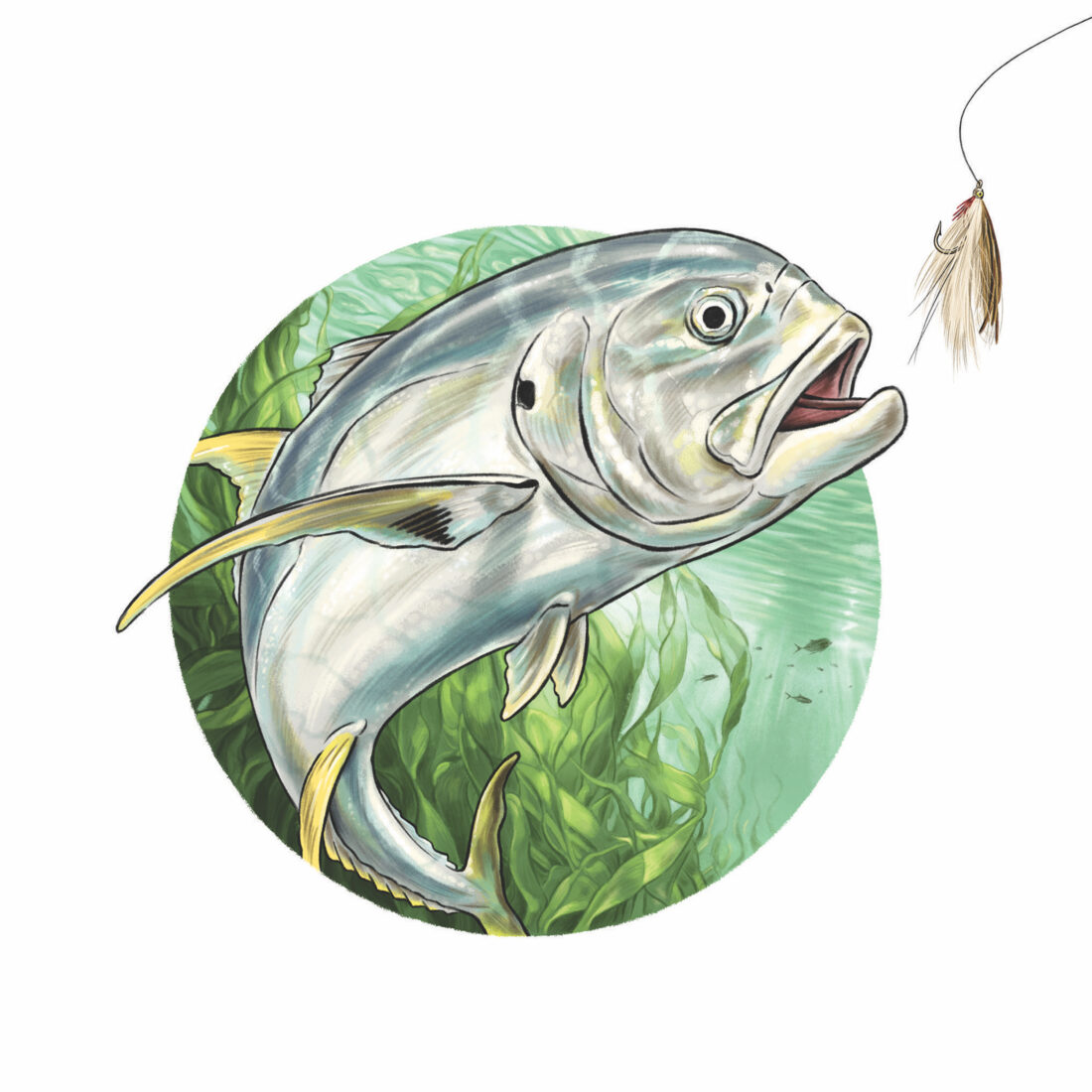
The fact that there were two hundred jack crevalle in the school didn’t make it easy. Nor did the three-foot whitecaps rocking the boat. Or the wind, strong enough to keep most anglers home. Or the circling sharks. But Hilary Hutcheson water-hauled a back cast anyway and lobbed a six-inch-long Game Changer fly as if she were flinging a wet squirrel. And when the fly hit the water on that spring day south of Vero Beach, Florida, three jacks fought to see which could eat it first.

With their tuna-shaped bodies and boxer’s disposition, jacks fight hard and swim relatively deep. Hutcheson, a Montana-based outfitter and guide, worked the fish with a bent fly rod for five full minutes before it could be pulled aboard, affixed with a numbered tag, and then released—the first subject in a new initiative, kicked off ahead of this year’s Lefty Kreh’s Tie Fest, to study jack crevalle populations. Supported by the American Saltwater Guides Association (ASGA), the Jack Project aims to enlist fishing guides and recreational anglers to help collect data for researchers from Florida International University and Mississippi State University who are seeking to shed light on the movements of jack crevalle for better management.
Jack crevalle travel in large schools along the Gulf and southeastern Atlantic coasts. Aggressive feeders, they hit lures and flies with explosive fervor. But they’re also fairly easy to catch on conventional tackle, and not a great item on the dinner table. Many anglers have therefore historically held jacks in low esteem; others consider them “trip savers”: When fishing for species such as tarpon or permit is poor, a couple of hard-pulling jack crevalle can prevent a bust. As popular fish populations face declining numbers, the pressure appears to have hit jacks, too.
Concern for the species first surfaced in the lower Florida Keys in 2005, when alarmed guides reported a dramatic drop in jack crevalle, especially larger ones. That eventually inspired a 2019 tagging project by the Lower Keys Guides Association (LKGA), which revealed that jacks tagged in the Keys moved north up the Florida coast as far as Port St. Lucie, some 250 miles away, and along the Gulf coast to Texas.
Along with the LKGA’s efforts, this new ASGA plan dramatically expands the research scope, thanks to support from anglers and guides. At Tie Fest, the nonprofit raised more than $100,000, money that will fund the research and equipment to surgically implant 140 acoustic tags in jacks caught off South Carolina, Florida’s Treasure Coast, the Keys, Louisiana, and Texas within the Jack Project’s first year. Additionally, traditional ribbonlike “spaghetti tags” will be available to guides not trained in the surgical techniques. Each of the fish will have small portions of its fin clipped for stable isotope analysis, which can tell researchers where the jacks spend their time along the coasts.
This mix of traditional science, the emerging discipline of local ecological knowledge, and citizen science is driving more research than ever before. “We also call it ‘user-inspired science,’” says Jennifer Rehage, a coastal ecologist at Florida International, “because the users—the fishers—are coming to us with a problem, and they are actively participating in finding solutions to the problem. It’s a true paradigm shift in the scientific approach.” One she and others hope will lead to a shift in the understanding of what drives a healthy jack crevalle population, and a change in appreciation for the species.
After all, it wasn’t that long ago when another fish that coursed these waters was dissed as a “trash fish” that no one wanted to catch. Its name: the Atlantic tarpon.